Object of the Month
Take an inside look at a masterpiece of the Italian Renaissance
Scroll Down
Marbled Tension of Flesh and Fury
Giambologna’s Hercules and the Centaur Nessus
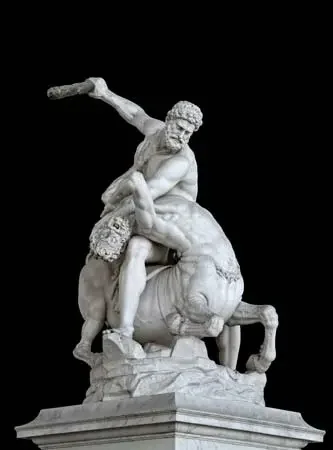
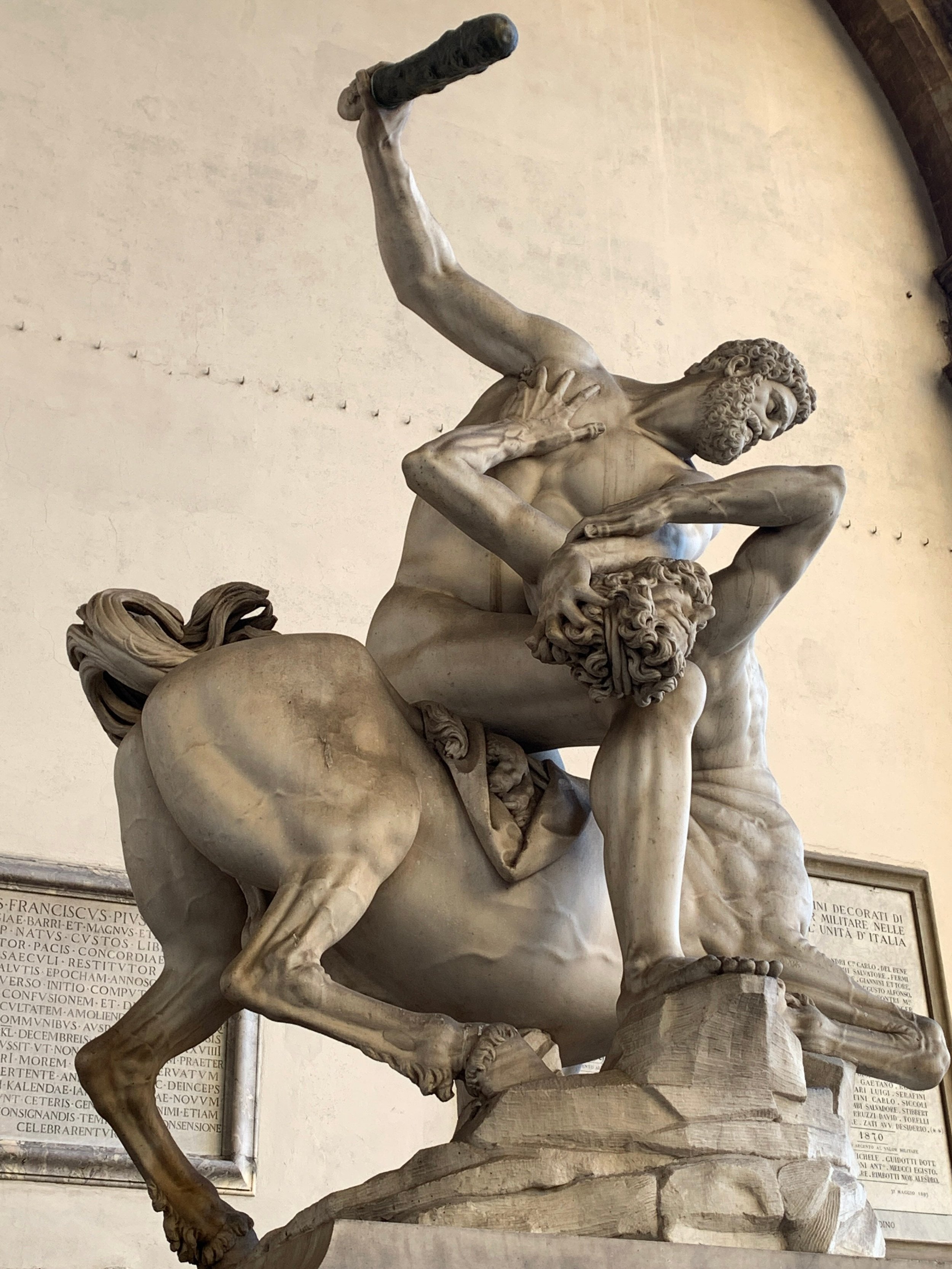
Hercules and the Centaur Nessus Giambologna, Flemish (active in Italy). Florence, Italy. Marble. Late Mannerism, 1595–1599.
I found myself returning to this sculpture not for its clarity, but for its refusal to resolve. It lingers in a space I could not easily categorize, somewhere between control and collapse.
In a frozen instant of muscular strain and impending retribution, Hercules twists his colossal torso as he subdues the centaur Nessus beneath him. Marble, a material often associated with permanence and calm authority, becomes in Giambologna’s hands something volatile. Sinew tightens. Veins swell. Flesh presses into flesh. The sculpture does not give us resolution. It traps us in the moment just before the blow falls. And that choice is everything. But what does it mean to witness a moment that refuses to conclude? Are we meant to anticipate the strike, or to question it?
What Is Happening?
The myth recounts Nessus’s attempted abduction of Deianira, Hercules’s wife. In retaliation, Hercules kills the centaur. Many visual interpretations emphasize the fatal arrow shot from afar, presenting the act as swift and morally clear.
Giambologna rejects that distance. Instead, he stages intimate confrontation. Hercules towers over Nessus, arm raised, body torqueing across its axis. Nessus twists backward, his human expression caught between resistance and surrender. This is the anticipatory moment. The suspended second before impact. The closeness is almost uncomfortable. It resists passive viewing. I do not feel like an observer, but something closer to a witness. Their bodies knot together so tightly that aggressor and victim nearly merge into a single sculptural mass. Where, then, does one body end and the other begin? And where do we stand within that entanglement?
Violence here is not abstract. It is immediate.
The Spiral as Experience
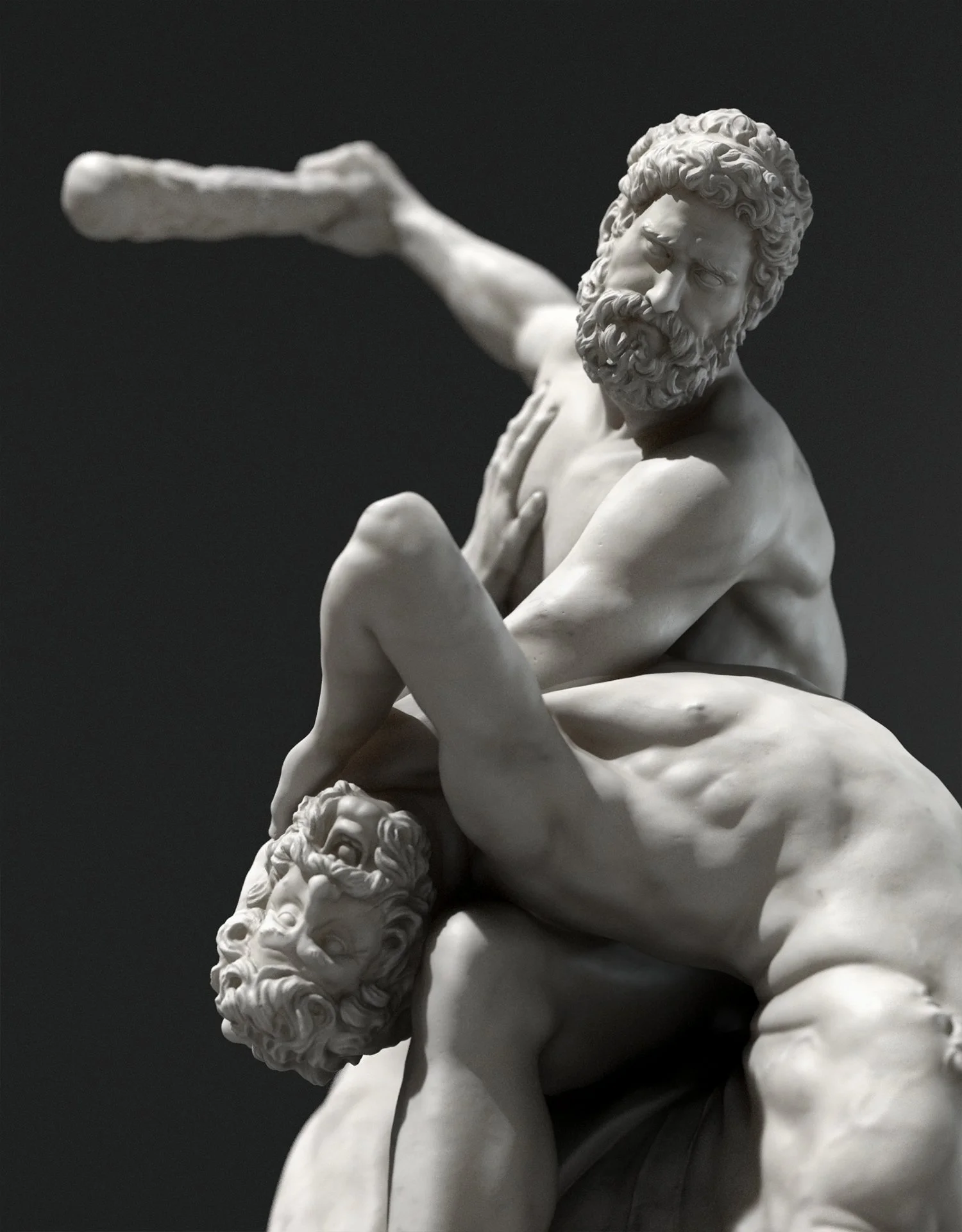
One of Giambologna’s most significant contributions to sculpture is the figura serpentinata, a spiraling composition meant to be experienced in the round. Hercules and Nessus refuse a single, stable viewpoint. You must move.
As you circle the sculpture, the narrative shifts. From one angle, Hercules appears controlled and dominant. From another, Nessus reads as painfully human. From yet another, their limbs intersect so dramatically that balance itself feels precarious. The sculpture unfolds through your movement. It destabilizes hierarchy and dissolves the certainty of a single perspective. This stands in contrast to Michelangelo’s David.
David also captures anticipation, but his tension is internal. The contrapposto stance stabilizes the figure, grounding him in controlled potential. The energy coils inward, disciplined and contained. Giambologna’s Hercules, by contrast, seems almost centrifugal. The torque of the torso and raised arm pushes outward into space. Stability is not assumed. It is threatened.
If Michelangelo gives us heroic restraint, Giambologna gives us kinetic spectacle.
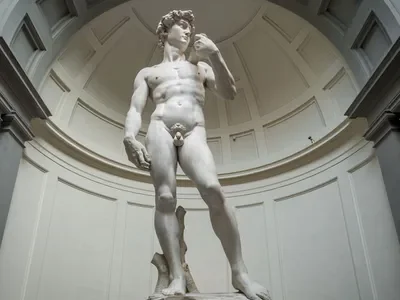
David. Michelangelo. Florence, Italy. Marble. High Renaissance, 1501–1504.
Surface and Sensation
Giambologna heightens the drama through surface contrast. Hercules’s musculature is sharply defined, each anatomical detail rendered with precision. Nessus’s hybrid form introduces a transition between human and animal, creating layered textures that shift across the body. Where their forms collide, the marble compresses visually, creating zones of pressure that feel almost tangible. The stone itself seems to strain beneath the force of the encounter. The material no longer feels inert. It feels vulnerable. This tactile immediacy anticipates the theatricality of the Baroque.
The sculpture is not content to be admired. It demands engagement.
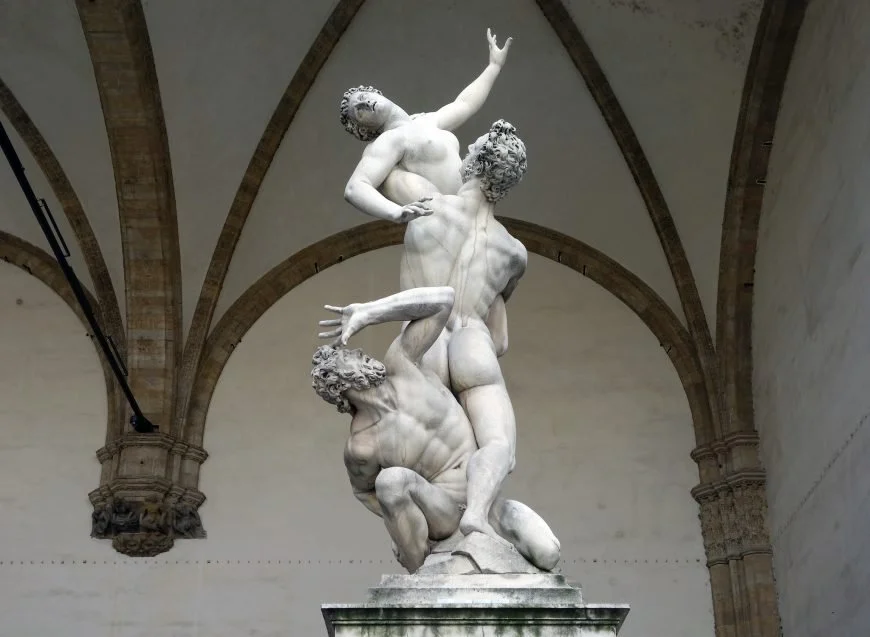
Rape of the Sabine Women. Giambologna. Florence, Italy. Marble. Mannerism, 1581–1583.
Comparison and Narrative Power
Like Hercules and Nessus, the work of the Sabine Women spirals upward in a vertically ambitious composition designed for public display. Both demonstrate Giambologna’s technical mastery and his commitment to multi-angled viewing. Yet while the Sabine Women emphasizes formal invention, its narrative was assigned only after its completion. Hercules and Nessus, by contrast, anchors its complexity within a known myth.
Here, virtuosity serves storytelling. And storytelling serves power.
Why Hercules and the Centaur Nessus?
In Florence, Hercules symbolized civic strength and Medici authority. The heroic nude had long functioned as a visual statement of political identity. By the late sixteenth century, however, Florence had shifted from republic to duchy. Power was no longer precarious. It was consolidated. Hercules reflects that shift. He does not merely defend, he dominates.
Yet Giambologna complicates that dominance. The raised arm hovers. The strike has not yet fallen. The moment remains unresolved. Perhaps that is where the sculpture’s power truly resides. Not in the act itself, but in its suspension. In the breath held too long. Marble here does not rest. It strains. And we, circling it, feel that strain with every step.
Are we moving around the sculpture, or is it, somehow, moving us?
Sources & Further Reading
Avery, Charles. Giambologna: The Complete Sculpture.
Cole, Michael. Ambitious Form.
Hall, Marcia. After Raphael.